

Motorcycle Service Intervals: When to Service Your Bike

Every motorcycle comes with a manufacturer-recommended service schedule, but that schedule is typically tested under relatively consistent, moderate conditions. Real-world Indian city riding — constant stop-and-go traffic, heat, dust, and short trip distances — is harder on a bike than those baseline conditions, which is why many riders find their bike benefits from service somewhat more frequently than the manual's outer limit.
What "Severe Service Conditions" Actually Means
Most manufacturer manuals include a note about "severe" or "adverse" conditions requiring shorter intervals, and if you look closely, the description usually matches daily Indian city commuting almost exactly: frequent short trips, extended idling in traffic, dusty environments, and stop-and-go riding. If this describes your riding, treating the shorter interval as your default — rather than the exception — is often the more realistic approach.
Typical Interval Guidelines (as a Starting Point)
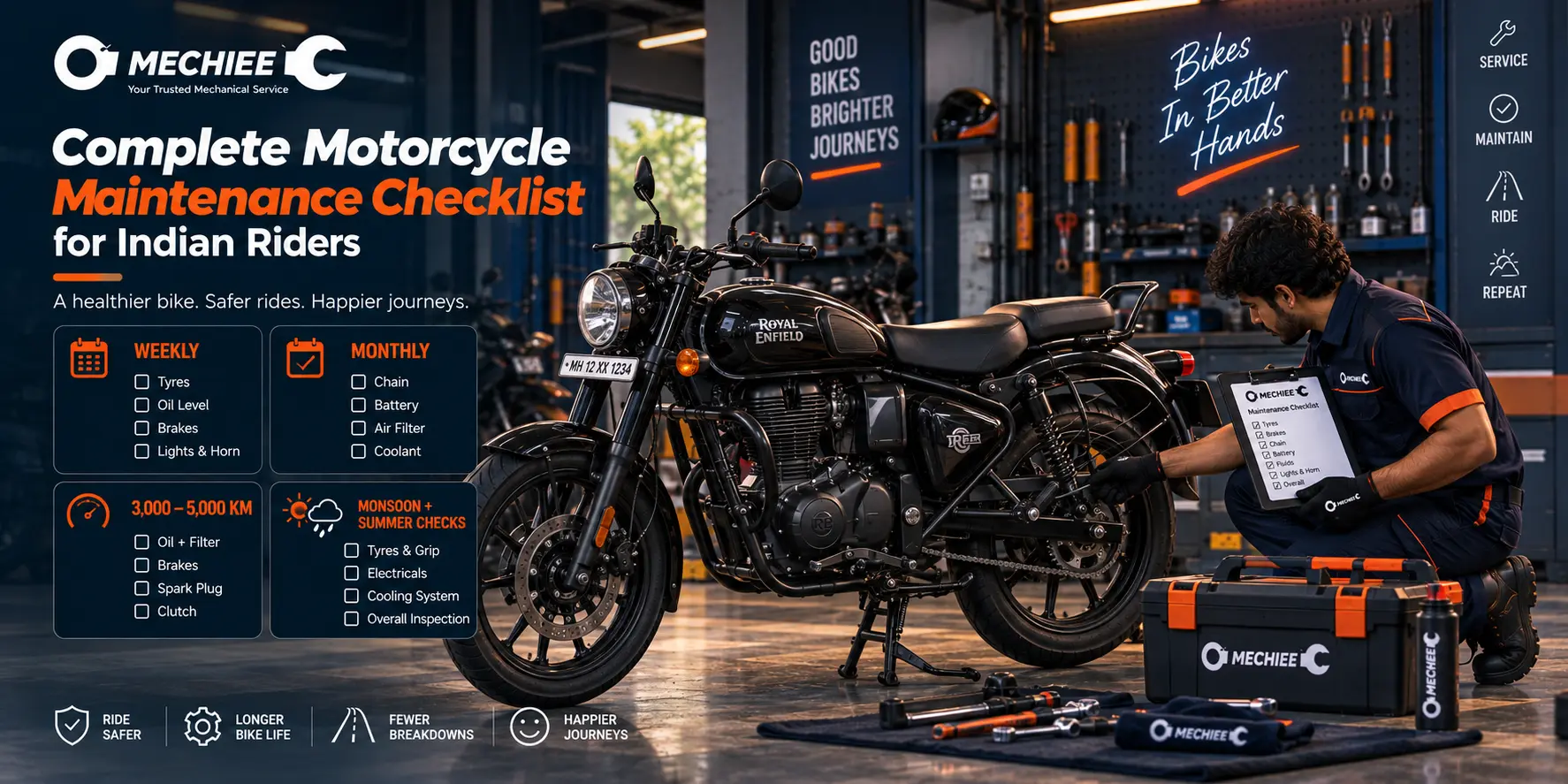
- Engine oil and filter: commonly every 2,500-3,500 km or 3 months for city riding, though this varies by bike and oil type — always check your specific manual.
- General inspection (brakes, chain, tyres, fluids): alongside every oil change is a practical rhythm, since the mechanic is already there.
- Air filter: check every service, replace based on condition rather than a fixed interval, since dust exposure varies a lot by route.
- Spark plug: typically every 8,000-10,000 km, though again this varies — a fouled or worn plug affects performance and mileage before it fails outright.
- Brake fluid: roughly every 1-2 years regardless of mileage, since it degrades from moisture absorption over time, not just use.
Why Skipping Services "Because the Bike Feels Fine" Is Risky
Many of the things a service catches — early brake pad wear, degrading oil, a chain approaching its wear limit — don't produce obvious symptoms until they're well advanced. A bike can feel completely normal to ride right up until a component that's been quietly wearing out finally fails.
Adjusting Intervals to Your Actual Riding
Two riders with the same bike model can reasonably need different service schedules. A rider doing mostly short city trips in heavy traffic puts more cumulative stress on the engine and clutch than a rider covering the same distance on steady highway rides. If your riding leans heavily toward the former, treating manufacturer intervals as an upper limit rather than a target is the safer approach.
Keeping a Simple Service Record
Even a basic note of what was done and when — oil change, brake pads, chain — makes it much easier to track what's actually due next, rather than guessing or relying purely on memory. This is especially useful if your bike changes hands eventually, since a clear service history is valuable to a future buyer too.
How Age Affects Service Needs, Independent of Mileage
Some components degrade with time rather than distance — brake fluid absorbs moisture whether the bike is ridden or not, and rubber seals and hoses age even on a bike that's mostly parked. A low-mileage bike that's several years old can still need certain time-based services even if it hasn't covered the distance that would normally trigger them, which is a detail riders with lightly used bikes sometimes overlook.
First Service vs Ongoing Services
The first service on a new motorcycle, usually scheduled earlier than subsequent ones (often around 500-1,000 km), plays a different role than later services — it's largely about checking that everything settled in correctly after the break-in period, tightening anything that may have loosened, and catching any manufacturing issues early while they're still covered by warranty. Skipping or delaying this first service is a common mistake among new bike owners who don't realize it's structurally different from a routine service later on.
Balancing Cost Against Risk
Riders sometimes stretch intervals specifically to save on service costs, but the math often doesn't favor this in the long run — a delayed oil change that leads to increased engine wear, or a skipped brake check that leads to a rotor replacement instead of a simple pad change, both end up costing considerably more than the service they were trying to avoid.
Doorstep Service and Consistency
One practical reason riders skip services isn't cost at all — it's simply the inconvenience of finding time to visit a workshop and wait. Doorstep servicing removes this barrier by bringing the mechanic to your home or office at a scheduled time, which in practice makes it considerably easier to actually stick to a proper interval instead of repeatedly postponing a workshop visit that never quite fits into a busy week.
Setting Reminders That Actually Work
A calendar reminder tied to a specific date, or better, one tied to your typical monthly distance, is more reliable than trying to remember an odometer-based interval from memory alone. Many riders find it easier to simply pick a recurring date each quarter and treat it as a standing appointment, adjusting only if the bike is clearly due earlier based on how it's been ridden.
What a Well-Kept Service History Is Worth Later
Beyond the day-to-day maintenance benefit, a consistent, documented service history has real value if you ever decide to sell the bike. Buyers reasonably pay more, and negotiate less aggressively, for a motorcycle with a clear, verifiable record of proper care compared to one with an unknown or inconsistent maintenance past — the discipline of sticking to a schedule pays off twice, once in reliability and again at resale.
Frequently Asked Questions
Does servicing too frequently waste money without benefit?
There's a reasonable middle ground — servicing far more often than needed does add unnecessary cost without meaningful benefit, but for most Indian city riders, the "severe conditions" interval described above is closer to appropriate than excessive.
Will my warranty be affected if I service more often than required?
Generally no — warranties typically specify a maximum interval, not a minimum, so servicing somewhat more frequently doesn't usually create a warranty issue. Always keep service records regardless.
What's the risk of consistently pushing service intervals to their outer limit?
Components like oil, brake pads, and the chain all wear faster under harder conditions than the interval was tested for, so consistently waiting until the last recommended kilometer increases the chance of a component being more worn than the schedule assumes.
Stay Ahead of the Schedule
Mechiee's Periodic Service is built around real Indian riding conditions, not just the manufacturer's baseline assumptions, with General Inspection available alongside it to catch anything the standard checklist might miss.
Is your bike due for service or inspection?
Don't wait for breakdown emergencies. Book an expert doorstep inspection or general service with Mechiee in under 60 seconds.


Comments
Log in to join the conversation→No comments yet — be the first to share your thoughts.