

Tyre Care for Motorcycles: Pressure, Tread & Replacement Guide
It's easy to overlook tyres — they don't make noise when something's wrong the way an engine or brake does. But every bit of acceleration, braking, and cornering grip your bike has comes down to a contact patch roughly the size of your palm. Tyre neglect is one of the more common contributors to avoidable accidents, and one of the easiest things to prevent.
Why Tyre Pressure Matters More Than You'd Think
Underinflated tyres flex more than they should, generating extra heat, wearing unevenly along the edges, and reducing fuel efficiency because of increased rolling resistance. Overinflated tyres reduce the contact patch and can make the bike feel harsh and less planted, particularly over bumps and potholes. Check pressure when tyres are cold (before riding, not after) for an accurate reading, since heat from riding temporarily raises pressure.
Reading Tread Wear
Most tyres have built-in tread wear indicators — small raised bars within the tread grooves that become flush with the surrounding tread as the tyre wears down. When you see these indicators level with the tread, it's time to replace, regardless of how the tyre looks otherwise. Also watch for uneven wear patterns:
- Center wear — often from consistently overinflated tyres or excessive highway riding
- Edge wear on both sides — often from underinflation
- One-sided wear — can indicate alignment issues or a riding style that favors one direction of cornering
Cracking and Aging
Tyres age even if they're not covering much distance, especially when parked in direct sun for long periods. Small surface cracks in the sidewall or tread grooves are a sign the rubber compound is hardening and losing grip, even if the tread depth still looks acceptable. An old, cracked tyre with plenty of visible tread left can still be less safe than a newer tyre with moderate wear.
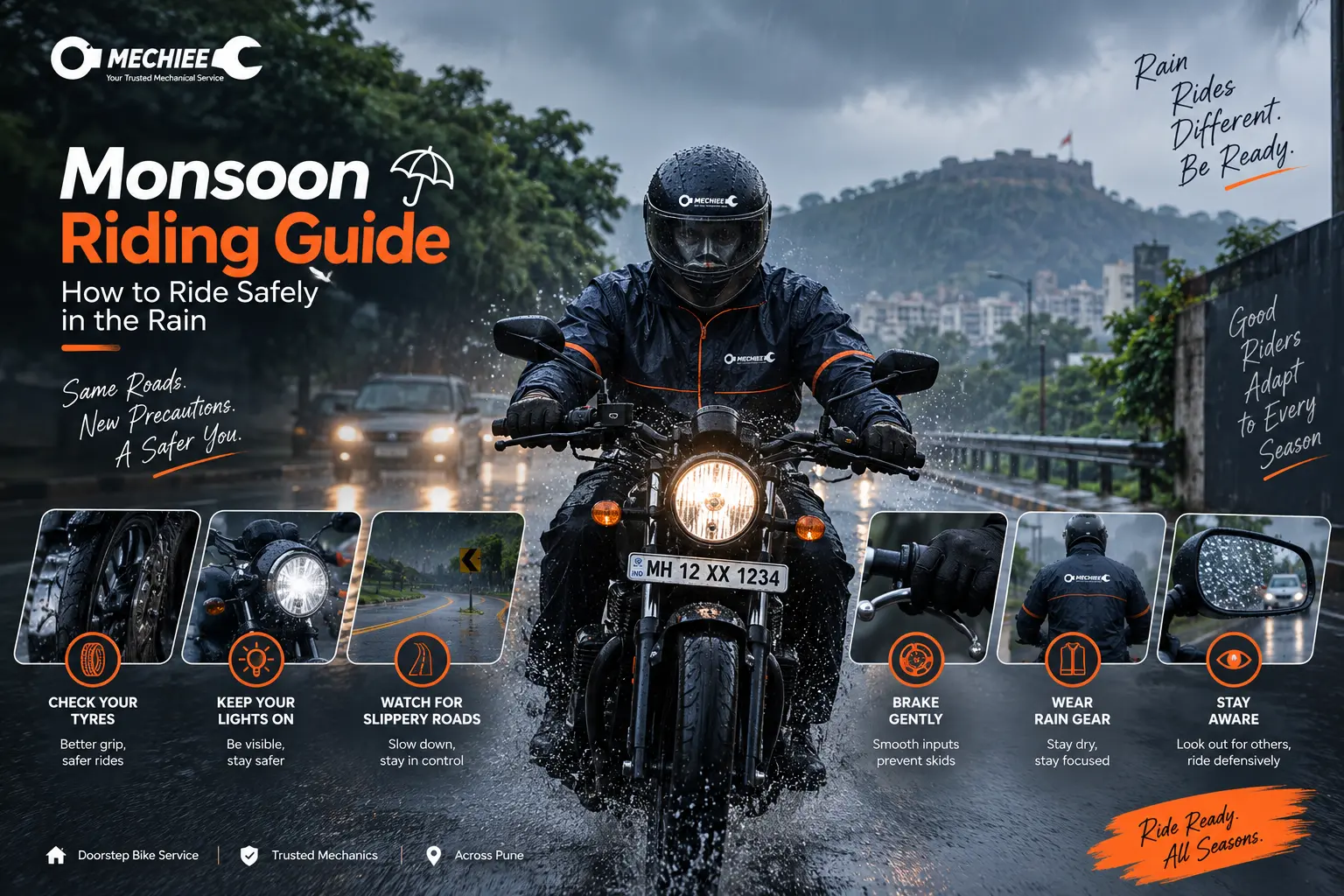
Monsoon and Wet-Weather Considerations
Tread depth matters even more in the rain — it's what channels water away from the contact patch to prevent hydroplaning. A tyre that's borderline in dry conditions becomes noticeably riskier once monsoon arrives. If you're due for a change and monsoon is approaching, it's worth doing it before the rains rather than after.
Wheel Alignment and Balancing
Misaligned wheels cause uneven tyre wear and can make the bike feel like it's pulling slightly to one side. Unbalanced wheels cause vibration, especially noticeable at higher speeds. Both are worth checking whenever you replace a tyre, and periodically otherwise, since they affect how evenly your tyres wear over their lifespan.
Understanding Tyre Types and Compounds
Tyres are broadly categorized by their intended use — commuter tyres prioritize longevity and fuel efficiency, sport-touring tyres balance grip and mileage, and off-road or dual-purpose tyres trade some on-road grip for capability on loose surfaces. Fitting a tyre type that doesn't match how you actually ride (an aggressive sport compound on a bike used purely for gentle city commuting, for instance) often means paying for performance you don't use while getting shorter tread life than a commuter-focused tyre would offer for the same riding.
Cornering Grip and Contact Patch
As a motorcycle leans into a corner, the contact patch shifts from the center of the tyre toward the edge. This is part of why center-only wear (from mostly straight-line riding) can leave the edges of a tyre relatively fresh in tread depth but underdeveed in grip character — a tyre can look like it has "plenty of tread left" while the edges, which matter most for cornering confidence, haven't worn in the same predictable way as the center.
The Real Cost of Riding on Worn Tyres
Beyond the safety risk, worn tyres often cost more in the long run than they save. Reduced grip means more cautious, sometimes less efficient riding; a tyre worn unevenly due to a known but unaddressed alignment issue wears out faster than its rated life; and the eventual failure of a badly neglected tyre — a puncture that can't be repaired, or worse — usually happens at a more inconvenient and costly moment than a planned replacement would have been.
Choosing Between Tube and Tubeless Tyres
Tubeless tyres generally deflate more gradually after a small puncture, giving you a better chance of noticing and addressing it before a sudden flat, compared to tube-type tyres which tend to lose pressure faster once punctured. If your bike supports tubeless tyres and you're due for a change, it's worth discussing this with your mechanic as part of the decision, particularly if you frequently ride routes with debris or nails.
Matching Tyres to Your Actual Riding, Not Just the Original Fitment
The tyres your bike came with from the factory are a reasonable general-purpose choice, but they're not necessarily the ideal option for every rider. Someone who rides mostly in the rain-heavy months, or mostly on rough, unpaved stretches, may benefit from a tyre compound better suited to that specific use than the factory-fitted default, which is chosen to be a broad compromise across many riding conditions rather than optimized for any one of them.
Frequently Asked Questions
How often should I check tyre pressure?
Weekly is a good habit, and always before a long ride. Pressure naturally drops slowly over time even without a puncture, due to gradual air permeation through the rubber.
Can I mix different tyre brands on the front and rear?
It's generally best to avoid mismatched brands and compounds, since front and rear tyres are designed to work together in terms of grip characteristics and how the bike balances during braking and cornering.
Is it safe to repair a punctured tyre, or should I always replace it?
Small punctures in the tread area can often be safely repaired by a professional, but sidewall damage generally cannot be safely repaired and calls for replacement, since the sidewall flexes constantly and a repair there is more likely to fail.
Keep Your Contact Patch in Good Shape
Since tyres are the one thing between you and the road, this isn't an area to guess about. Mechiee's Tyre Replacement and Wheel Alignment services, along with Wheel Balancing, are all available at your doorstep.
Is your bike due for service or inspection?
Don't wait for breakdown emergencies. Book an expert doorstep inspection or general service with Mechiee in under 60 seconds.
Comments
Log in to join the conversation→No comments yet — be the first to share your thoughts.